

Thumbtack, a popular online marketplace connecting service providers with potential clients, has gained significant attention in recent years for its seemingly “convenient” platform. However, beneath the surface, there are several reasons to be concerned about how the company’s business model impacts the very people it claims to help – the creators, or service providers. In this article, we will explore Thumbtack’s business model and discuss why it can be detrimental to the creators on the site – ya know, the people who keep this site relevant in the first place. After spending 2 years using and researching the platform, Thumbtack is an extremely problematic service provider. Even though I have booked quite a few clients from using the site, I have hardly made a profit from the clients I have booked due to the fees.
The Thumbtack Business Model
Thumbtack’s business model revolves around connecting individuals seeking various services with professionals who can provide them. Potential clients search Thumbtack for lots of services, ranging from home improvement to photography – when they find someone they are interested in working with, they message the service provider. The moment a potential client reaches out, the service provider is paying for that conversation, no matter the outcome. On the surface, this model appears beneficial for both parties, as clients can find professionals, and service providers can secure jobs. However, a closer examination reveals several issues that disproportionately affect the creators.
- Paying to Play
One of the most significant criticisms of Thumbtack is its pay-to-play model with what appears to be purposefully ensuring customers looking to hire don’t understand how the business model works. Most customers, if they’re smart, shop around for whatever service they are seeking – meaning, they are reaching out to 2-5 service providers for their one project. That all seems alright! Until you realize that every single service provider that was contacted paid Thumbtack for the potential client to reach out to them. For example, lets say a client with a budget of $1000 reaches out to 5 potential service providers but decides not to hire any of them. Using one of my own recent $1000 “leads” as a reference, each creator paid $45 for that conversation. Leaving Thumbtack with a $225 profit, while each creator is in the red. This happens thousands of times a day, ultimately putting hundreds of thousands of dollars in Thumbtack’s pocket each year, while not offering service providers much customer service or leniency in terms of refunds.
More often than not, potential clients will reach out to a contractor and never respond to them again. I have spent over $400 on Thumbtack leads in the last 6 months, 75% of the potential clients never responded and Thumbtack’s response to that is: “Thumbtack gets your business in front of customers for free. You only pay for customers who contact you to learn more about working with you.”
There is no publicly set metric or percentage Thumbtack charges per lead, leaving what they charge completely open-ended and whatever they think is appropriate, while service providers are paying anywhere between 2-20% of the potential job’s entire cost. How does Thumbtack decide what to charge creators? Truly, we would love to know.
In case you need another example, someone reached out to me to shoot an event for $3000, even stating in their message they had no intention of hiring anyone at this point, they are just looking around. I paid Thumbtack $75 for that ‘lead’ – a lead that clearly stated they weren’t actually looking to hire anyone at the moment. I asked for a refund with proof that the client wasn’t looking to hire, to which Thumbtack responded with: “You can either have a Thumbtack credit or no refund at all”. So of course I went for the credit to get some semblance of my money back, but even so, that forces me to stay on the platform because I have 75 Thumbtack bucks sitting there. The longer I’ve spent on Thumbtack, the more they seem to be moving toward the “scam” side of the spectrum.
Thumbtack’s entire payment model benefits Thumbtack off the backs of the service providers they claim to be supporting. Thumbtack does a remarkable job of hiding how their platform works from potential customers too – thus; fostering an uneducated clientele who don’t realize they’re causing contractors to lose hundreds or even thousands of dollars a year to start a bunch of conversations they have no intention of finishing while Thumbtack profits $300 million per year, on average.
- Inconsistent Lead Quality
Thumbtack’s lead generation system can be highly inconsistent, leading to frustration among service providers. Many creators report receiving leads that turn out to be either irrelevant or low-quality. In such cases, service providers have already spent their hard-earned money, only to receive little or no return on their investment. This inconsistency can discourage creators and lead to financial losses.
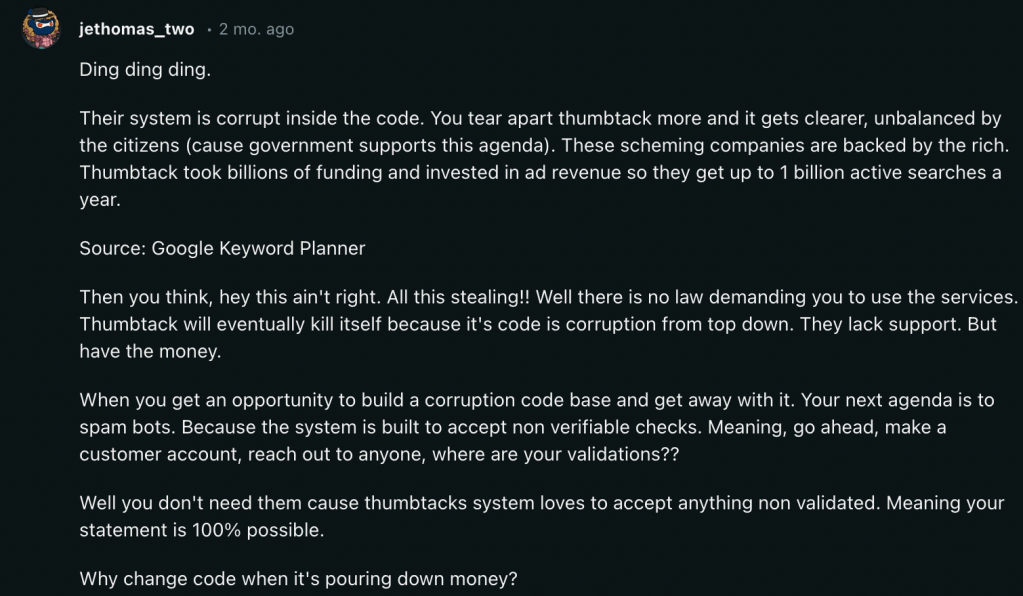
Thumbtack has intricate settings to ensure that potential clients can understand your rates and that Thumbtack will “match” your service with potential clients that fit your service. However, after spending a couple hours going through to set up my preferences and prices, I am still getting contacted (and paying) regularly for leads that don’t fit my services. It’s also important to note that although it’s important for “low budget” clients to be able to enjoy the same services others do, the clientele on Thumbtack can be abrasive, unkind, and some users even believe that Thumbtack uses bots to message service providers; thus, putting more money in their pocket.
- High Competition and Price Pressure
Thumbtack’s platform encourages fierce competition among service providers, often leading to a race to the bottom in terms of pricing. When multiple providers bid on the same job, clients tend to choose the lowest bidder, which can result in creators undercutting their prices to win contracts. This relentless price pressure can make it challenging for creators to maintain fair pricing and sustain their businesses the the while stirring animosity in the communities of the service providers.
- Limited Control and Customer Data
Thumbtack retains significant control over the interaction between clients and service providers, limiting the latter’s ability to build long-term relationships with customers. Creators often lack access to customer contact information and are dependent on Thumbtack to facilitate communication. This dependence can hinder creators from establishing direct relationships with clients, reducing their ability to market their services independently. They even ensure that if you put your email on your own profile, it is asterisked out and the clients can’t see it. Forcing clients, whether they’re hiring or not, to contact through Thumbtack so they can get paid by the service provider who is only losing money through some of these conversations.
- Escalating Fees
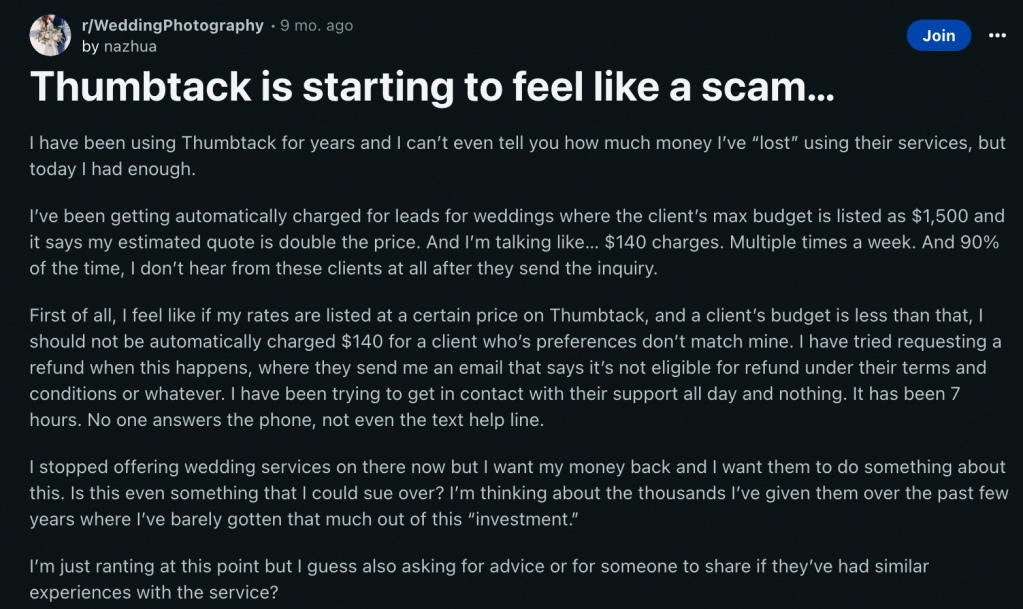
Thumbtack’s fees can escalate quickly, further eroding the earnings of service providers. We found another photographer on Reddit who sparked an interesting conversation about Thumbtack’s “scam” like behavior:
With other users responding:

While Thumbtack offers a seemingly convenient platform for connecting service providers with potential clients, its business model raises concerns for creators. The pay-to-play system, inconsistent lead quality, price pressure, limited control over customer data, and escalating fees all contribute to an environment that can be detrimental to service providers.
Creators on Thumbtack should carefully consider the costs and risks associated with using the platform. It is essential for them to weigh the potential benefits against the financial burdens and uncertainties that Thumbtack’s business model presents. In the end, the platform may not be as creator-friendly as it initially appears. Creators should seek out alternative avenues such as Google or Facebook ads for finding and securing clients that may be more favorable for seeking a fair and sustainable business model.





 We Shoot Shows
Leave a comment